Blog Feed

The State of Things: July 2020

As of July 25, 2020, my liquid next worth stands at about $55,500. My average monthly spending has decreased to below $2000.

A lot has changed since the last update to this blog—I’m speaking, of course, of COVID-19.

I left New York in March and came back to Washington state to ride out the pandemic with my family. Since then, I’ve been working remotely. The second wave of COVID has come as no surprise given the delayed and halfhearted response to the pandemic in the U.S., and so even as things are going back to normal in other developed nations, we languish in a state of partial shutdown—and remote work continues.

I feel incredibly fortunate to be able to work remotely from the safety of my childhood home while everything in the country seemingly goes to hell in a handbasket. And work I have, as I have become much more integrated into the company since the last update and therefore find myself regularly working 10 hour days. On Friday, my boss asked me to put together a report of how much time I allocate to various tasks at work, as the new head of the department wants this data from everyone to do… something or other. This made me wonder about what working hours are considered normal at the company, so I asked him how much he works on average per week. He said 50-60, and some people on the team put in even more.

Oh my God. Is this normal?

Before this I’d asked some of the people I’ve gotten closer to on my team how much they work on average, and their answers vary but are all some variation of “too much.” Yet even as they complain about being overworked many of them seem to take a sort of pride in working this hard—of somehow being martyrs for the cause. Of course, in this case the cause is ultimately to further line the pockets of the already extremely wealthy.

But maybe I’m too cynical.

Regardless, there seems to be an unhealthy acceptance and even quiet celebration of working ridiculous hours at Finance Firm. I suspect that at least a part of this might be able to be attributed to East Coast work culture, and I imagine that the situation would likely be similar at any other financial firm in the city.

Even as I become more comfortable in my workflow and with my coworkers, this further cements the awareness that this isn’t something that I want to be doing forever. But the work experience is invaluable, the name of the firm on my resume will no doubt open doors, and most importantly, I am making more money than I ever have before, by a significant margin.

After completion of my 6-month probationary contract at the beginning of this month, my base salary was increased from $55k to $62k. My position is eligible for OT paid at 1.5x, and I’m glad for that as my average working hours per week have inflated to 50. Given this, I ran the numbers on my expected income over the course of a year if everything remains constant:

Base salary: $62,000
10 hours OT / wk over 52 weeks: $23,250
401k match: $7,440
Expected year-end bonus: $10,000
Total compensation: $102,690

Not bad at all. After the maximum 401k deduction (at $19,500 for 2020) and subtracting taxes, I should have a net salary of $53,725. Assuming living expenses of $27,600 per year (as calculated in the previous update), $26,125 is left to contribute to my Roth IRA and taxable brokerage account. Adding back in my 401k contribution plus employer match, that leaves $53,065 saved over the course of the year. Plugging this savings rate and FIRE net worth target into this very handy tool, I should hit my FIRE target of $800,000 in 6 to 14 years—which would be ages 32 to 40.

Of course this assumes a lot of things—that my salary only grows with inflation, that I work the same amount of overtime, that my spending habits remain the same, that I stay at the same job with the same benefits, etc., etc.

But I do find it helpful to run these numbers, both because I am a nerd for financial planning and because it gives me an indication that I am on the right path.

I do wonder when the impact of COVID-19 will be reflected in the market, if ever—the performance of the major indexes seems to be decoupled from reality at this point—though I do understand that FAANG and related stocks have been far outperforming the rest. Indeed, FinanceFirm is also performing extremely well these days.

This uncertainty does make me nervous, but I have to remind myself that sticking to my strategy and consistently contributing to my investment accounts regardless of market conditions is the only reliable way to achieve FIRE. Either the market will recover after a downturn and go on to reach new highs as it has done every single time before, or world economies irreparably collapse—in which case I will likely have bigger problems than the size of my retirement stash.

So for now, I’ll keep doing what I’m doing, moving closer to FIRE with each paycheck.
The State of Things: February 2020

As of February 12th, 2020, my liquid net worth stands at $34,000.

My current monthly expenses average $2,300, which works out to $27,600 per year.

Assuming a 3.5% safe withdrawal rate (SWR), which is somewhat more conservative than the 4% suggested by the Trinity Study, my FIRE number is about $788,500. Let’s call this $800,000 to make things easy. Note that this number is in 2020 dollars; after inflation, it will be correspondingly higher.

As of January 2020, I have a 401k for the first time. I am contributing 30% of my pre-tax income (currently $55,000), and with the company match, I am getting an effective contribution rate of 42%. The company match fully vests after 4 years, though, which is either an indication that I need to be more conservative in my projections, or an encouragement to stick it out at FinanceFirm for at least this amount of time!

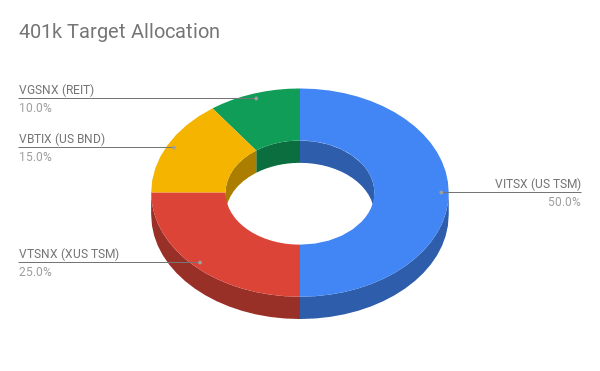
I’m very fortunate that FinanceFirm’s 401k plan is through Vanguard and offers access to Institutional shares, which have very low expense ratios. The asset allocation that I’ve settled on for my 401k is a variation on Rick Ferri’s Core Four portfolio, with the following holdings:

50% VITSX (Total US Stock Market)
25% VTSNX (Total Ex-US International Stock Market)
15% VBTIX (Total US Bond Market)
10% VGSNX (US REIT)

Because I love charts and spreadsheets, here is a visualization of the above target allocation:

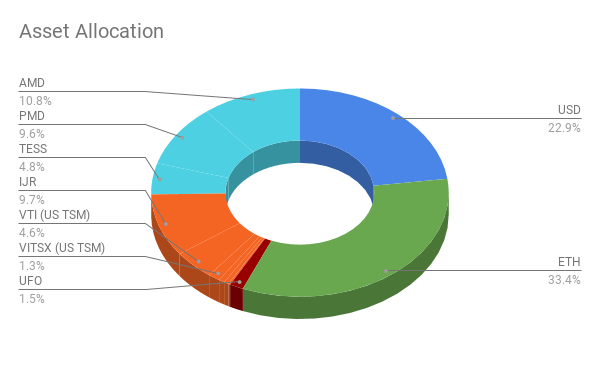
However, because until relatively recently I haven’t had much idea about the right way to go about investing for the long haul, my current liquid net worth looks more like this:

Green is Ethereum, dark blue is cash, light blue are individual stocks, orange are broad index funds, and red is UFO, an ETF which tracks space tech companies.

Suffice to say, my current portfolio is a bit of a mess. As you can see, the cryptocurrency Ethereum currently makes up a full third of my total net worth, and the majority of my equity holdings are in individual stocks (to be honest though, I got VERY lucky on AMD and Ethereum).

All things considered, it might be time to derisk my portfolio.

I intend to continue to contribute 30% of my income to my 401k. This gives me a little buffer in case I go over $2,300 per month in expenses, and at the end of each year I intend to put any overage into my Roth IRA.

Assuming that the ONLY money I save per year is through my 401k and that the savings rate, company match, and my income remain the same ( adjusted for inflation), I will achieve FI in between 14 and 23 years—this is based on the very handy website https://portfoliocharts.com/. That puts me at between 40 and 49 years old. On target!

Of course, as with all things, every one of these factors is subject to change. But I hope to be able to look back at this someday as a reference point for the beginning of my journey.

The Dream of FI

Today my alarm went off at 8:00.

Monday, again.

Wanting to get a jump on the day, I got out of bed without hesitation, showered, groomed, and headed out the door to the subway station. The train was crowded, as always, and I stood in the corner looking at my phone until it was time to get off.

Having gotten off the train, I trudged up the station stairs to be greeted by rain and tourists hauling their suitcases into taxis. Dodging the tourists, I got to the office building, swiped my card, and boarded the elevator.

I sat at my desk, logged into my computer, and entered my arrival time into the weekly timesheet. Having done this, I went to one of the office kitchens to get myself a mug of coffee and a yogurt. A habitual start to the day.

For the rest of the day I ground away on completing some records for 2019 and put together a report that would be due in a couple weeks. At some point in the middle of this I snuck off to the gym for a workout and thereby a reprieve for my body which instinctively needs to move. Come 5:00, I lingered for just long enough not to feel guilty about leaving too early, then headed home to cook myself dinner and relax.

And tomorrow will be much the same.

I just got this job working on the recruiting team at FinancialFirm a month ago. All things considered, I was excited for it. My previous employment as an adventure tour guide allowed me to see a lot of the country, but at the cost of working just about 24/7, dealing with difficult tourists, and getting compensated far too little for the effort. In comparison, this has been a cakewalk so far.

But is this really all I have to look forward to for the rest of my working life? Sitting in an office staring at a computer for most of the day? Aging through the rest of my youth in a low-wall cubicle? The pay is good, the people are nice enough, and they have free snacks and a salad bar for lunch. And already I dream of leaving.

Enter FIRE.

If you haven’t already surmised, the focus of this blog is my own path to FIRE — Financial Independence Retire Early. This movement has picked up a lot of traction in recent years with bloggers like Mr. Money Mustache and The Mad Fientist inspiring thousands of people like me to take the steps necessary to retire far earlier than the traditional age 65—Retire Early—or at least to have the means to quit a job if it doesn’t suit you; to make work optional rather than necessary—Financial Independence.

Now, a little bit about me.

I grew up in the rural Pacific Northwest of the USA. I got a degree in German Studies from a liberal arts college in the area in 2016, as truthfully at the time I was more interested in experimenting with psychedelics and hiking in the woods than I was in pursuing a rigorous course of studies. Following this I moved to Germany to teach English for a year, moved back to the States and got my first taste of office life at a nonprofit in Seattle, quit that job to ride my motorcycle around the country, applied to grad school and got rejected from every university, spent a summer driving tourists around the country as a tour guide, then moved to New York and landed a job in recruiting at FinanceFirm.

At 26 years old now, that just about brings us up to speed.

I’ve spent the past few years trying out a lot of different things, and what I’ve discovered so far is that, whenever you get paid to do something, there’s usually a good reason that the job is compensated. Who would work in an office if they didn’t get paid to do so? Even tour guiding involves a lot of logistics, planning, and answering the same question 500 times (no, you really shouldn’t drink the river water).

My father used to tell me: Work is a four-letter word, after all. I didn’t really understand what he meant until I got a bit older, but I do now. And true to form, dad retired at age 56, having been inspired by an old TV ad from an Canadian life insurance company. Freedom 55 was the slogan.

Which brings us to the Freedom 45 Project. My goal is to beat dad to FIRE by ten years.

I don’t need a lot to be happy. Eating well, exercise, fulfilling relationships, spending time in nature, and expressing myself creatively are just about all I need. And work is a major distraction from these things. My motivation to FIRE really just boils down to this.

Why spend more time on this earth exchanging life energy for money than you have to?

Western culture, particularly North American, is fiercely consumeristic. I don’t need to tell you this; you already know. Many Americans spend not only all of their disposable income, but even more by going into debt. How many people do you know who are living paycheck to paycheck? It’s not only low-earners; there are investment bankers who can barely pay the rent, doctors who take out loans to buy a second sports car, programmers who are floating five figures of credit card debt. And the reason for this is that we are generally conditioned by our culture to inflate our spending to match our income.

FIRE represents a conscious break from this pattern. Rather than inflating spending as income rises, you choose to resist lifestyle creep and instead invest this money with an eye to the future. You buy only what you really need, and pass on the things that you know don’t really make you happy anyways.

At the end of the day, the hope of decades of healthy life to pursue what you want, when you want to, sounds much more appealing to me than working until you are no longer physically capable of doing so in order to buy more things that bring only fleeting satisfaction at best.

Perhaps this sounds appealing to you as well?

See the next post for information about the nuts and bolts of the beginning of my FIRE journey.